What is ISO 42001, and does your company need it?
Updated 4 Oct 2026
ISO 42001 is a voluntary standard for managing AI inside a company. It is not a law, and a certificate does not make you compliant with the EU AI Act. In our experience it helps most once you sell to larger buyers. Facts checked 4 October 2026.
If a customer just asked whether you have ISO 42001, take a breath. It’s a voluntary standard, not a law, and you’re not late. But voluntary doesn’t mean unimportant. We’ve seen it help companies stand out and win clients, especially once they start selling to bigger businesses. Whether it’s worth doing right now mostly depends on what stage you’re at.
One thing to know early: getting certified doesn’t mean the EU treats you as compliant with its AI Act. Some of the guides we read blur the two, and that’s part of a bigger pattern. What you hear about ISO 42001 often depends on what the person telling you is selling. We don’t sell certification, software or consulting, so here’s the plain version. This alphabet soup confuses everyone, including people who work in compliance.
What is ISO 42001, in plain words?
ISO 42001 is a standard for managing AI inside an organisation. Its full name is ISO/IEC 42001:2023, and it comes from ISO and IEC, two international standards bodies.
It describes a management system. That is a set of policies, roles, checks and habits that you run and keep improving. For AI, that means things like who owns AI decisions, how you spot risks, how you think about the impact on people, and how you review it all over time.
What it does not do: it does not test your model, and it does not judge whether your AI is good. It checks that you manage AI in an organised way.
It can apply to any organisation that builds, provides or uses AI, whatever its size.
Why does everything you read about ISO 42001 sound different?
What you read depends on who wrote it. Certification firms, software platforms, trainers and consultants each describe ISO 42001 around what they sell, so the advice often contradicts itself.
In the guides we read, one said every organisation using AI needs it. Another said certification helps you meet the EU AI Act. A third had out-of-date EU dates. We won’t name them. We just want you to know the pattern exists.
We are a directory, and we earn from listings. Firms can pay for a clearly labelled Featured slot, which never changes rankings. We don’t do audits, certify, consult or sell software, and nothing in this guide changes based on which route or firm you pick. That is also why we will tell you when to wait. You can read how we make money on our independence page.
Do you have to get ISO 42001, and is it worth it anyway?
No, you don’t have to. ISO 42001 is voluntary, and no law requires a certificate. Whether it is worth it depends on who you sell to.
Our view: it is a competitive edge, so time it to your stage. We have seen companies win clients on the back of ISO 42001 certification. It helps you stand out and builds your reputation as a company that takes AI seriously. But it is an investment. If you are a small company still fighting for your first few clients, it can wait. Spend that energy on the product and on winning customers. If you are scaling, or starting to sell to larger companies, this is when it makes a real difference.
That is our experience, not a rule. Nothing here promises a certificate will win you a deal.
The official surveys point the same direction on one thing: larger businesses use AI the most.
| Market | All businesses | Large businesses | Source |
|---|---|---|---|
| US | 19.8% (May 2026) | 37% (250+ staff) | US Census Bureau |
| EU | 20.0% (2025), up from 13.5% in 2024 | 55% | Eurostat |
AI use is growing fast, and about half of large companies in the EU already use it. This table shows who uses AI. It does not show that buyers demand ISO 42001, and we are not claiming that.
When to invest, when to wait
- Wait if you are still winning your first few customers and nobody has asked for it.
- Start planning if larger buyers are beginning to send AI questions in security reviews.
- Invest if you are scaling and selling AI to bigger businesses, where a certificate can set you apart.
What about the EU AI Act?
An ISO 42001 certificate is not an EU AI Act pass. The European Commission explains that presumed compliance comes only from harmonised standards. These are standards developed by CEN and CENELEC, the European standards bodies, and listed in the EU’s Official Journal. The Commission also says using standards stays voluntary, and providers can use other frameworks. Its page on standardisation does not mention ISO 42001.
Our view: ISO 42001 is useful evidence of good governance, not a shortcut. This corrects a mix-up we saw in several guides.
The dates matter too. The Commission’s timeline says prohibitions and AI literacy duties applied from 2 February 2025, and rules for general-purpose AI models from 2 August 2025. Rules for high-risk AI systems used in areas like employment and education apply from 2 December 2027, and for AI built into regulated products from 2 August 2028. The rules are still settling, so check the Commission’s page for changes. This is not legal advice, and whether the Act applies to you is a question for a lawyer.
How is ISO 42001 different from ISO 27001 and SOC 2?
ISO 42001 covers how you manage AI. ISO 27001 covers information security, and SOC 2 reports on your controls. They sit side by side and none replaces the others.
| ISO 42001 | ISO 27001 | SOC 2 | |
|---|---|---|---|
| What it covers | How you manage AI: risks, impact on people, the AI lifecycle | How you manage information security | Your controls, checked against criteria from the AICPA |
| What you get | A certificate | A certificate | An assurance report from an auditor |
| Who issues it | A certification body, ideally accredited | A certification body, ideally accredited | A CPA firm |
Source: ISO catalogue page for ISO 42001, AICPA for SOC 2. Checked 4 October 2026.
A few plain lines to go with it. The AICPA says CPAs and CPA firms provide SOC reports, and that it sets the professional standards for them. ISO 42001 is built as a management system with a plan, do, check and improve cycle, and we understand it shares its basic structure with ISO 27001. That shared structure is why habits from one can carry over to the other. We have left out certificate lengths and audit cycles here because we could not check them against a primary source this week.
If SOC 2 is the standard you are chasing first, our SOC 2 cost page shows published prices with sources and dates.
Who can certify you for ISO 42001?
Independent certification bodies certify you, and ISO does not certify anyone itself. A certification body is a company that audits your management system and issues the certificate. Accreditation means an official accreditation body has checked that the certification body itself is competent. Bodies vary, and some are accredited while others are not.
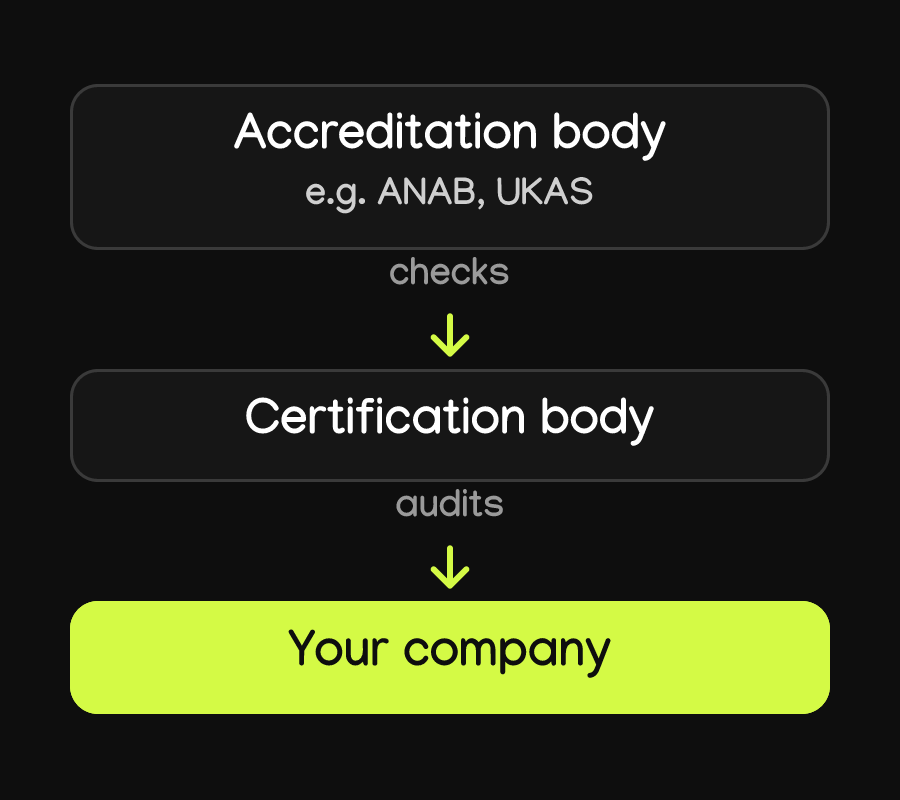
Our view: check who signed the certificate, and know that your vendor’s certificate does not cover you. Ask whether the body is accredited for ISO 42001 specifically. And using an AI service that holds ISO 42001 does not certify your company. You still need your own audit.
Three firms in our directory publicly state ANAB accreditation for ISO 42001, in alphabetical order: A-LIGN, Coalfire and Schellman & Company. ANAB is the ANSI National Accreditation Board, a US accreditation body. A-LIGN’s own announcement names ANAB and is dated 23 October 2024. We have not confirmed any of the three in ANAB’s own register, so on our site these show as “Firm states”, not “Verified”.
These firms are listed in our directory. Firms can pay for a labelled Featured slot, which never changes rankings. Naming them here isn’t a recommendation, so check any provider’s certificate and accreditation yourself. How we make money: our independence page.
Our full list of ISO 42001 certification bodies shows how many we list and how many we have checked in an official register, with dates. Those numbers update when the data does. Our methodology explains how we check.
What this guide does not cover
This guide does not tell you how to get certified step by step, what it costs or how long it takes. We left costs and timelines out because we found only vendor estimates, not sourced figures. It is not legal or audit advice, and it does not tell you whether the EU AI Act applies to you.
Tell us what you need and get 3 to 5 quotes from firms matched on fit. Free for buyers.
Get quotesFirms to consider
Listed by most verified credentials, then alphabetically. Payment never changes this order.
- Prescient Security & Assurance
- A-LIGN
- BARR Advisory
- Coalfire
- Schellman & Company
- BSI Group
- Bureau Veritas
- Advantage Partners
Questions
Is ISO 42001 mandatory?
No. ISO 42001 is a voluntary standard, and no law requires a certificate. A customer may still ask for one in a questionnaire or contract, which is a business decision on their side. If a buyer asks, you can answer on your own terms: certified, in progress, or not yet.
Does ISO 42001 make me compliant with the EU AI Act?
No. The European Commission says only harmonised standards, developed by CEN and CENELEC and listed in the EU's Official Journal, give a presumption of compliance. It also says using standards is voluntary. ISO 42001 can be good evidence of governance, but it is not a shortcut.
Does my AI vendor's ISO 42001 certificate cover my company?
No. A certificate covers the organisation and scope named on it. If you use an AI service that holds one, that helps your own assessment, but your company still needs its own audit to hold its own certificate. Always read the scope on any certificate you are shown.
Is an ISO 42001 Lead Auditor course the same as company certification?
No. A Lead Auditor course trains a person to audit. Company certification is an audit of your organisation's management system by a certification body. A person holding a course certificate does not mean their employer is certified, and the reverse is also true.
Do I need ISO 42001 if I already have SOC 2 or ISO 27001?
Those cover different things. SOC 2 and ISO 27001 are about security and related controls. ISO 42001 is about how you manage AI, including risks and impact on people. Having one does not replace another, though the management system habits you built can carry over.
Sources
- ISO/IEC 42001:2023, AI management systems (ISO catalogue page), checked 4 Oct 2026
- European Commission, AI Act standardisation, checked 4 Oct 2026
- European Commission, regulatory framework for AI (application dates), checked 4 Oct 2026
- AICPA, SOC suite of services, checked 4 Oct 2026
- A-LIGN, ISO 42001 accreditation announcement, checked 4 Oct 2026
- US Census Bureau, AI use by businesses, checked 4 Oct 2026
- Eurostat, use of AI in enterprises, checked 4 Oct 2026
It takes about two minutes.
Get quotes